

A slow-draining kitchen sink is not always caused by a blocked pipe. Food debris in the strainer, a restricted drain assembly, buildup in the P-trap, insufficient pipe slope, or an improperly installed appliance connection can all reduce drainage flow. The system should be checked in a logical sequence. Buyers should also confirm the drain position, included fittings, and installation documentation before placing an order.
Common Causes of a Slow-Draining Kitchen Sink
Common causes include food residue and grease buildup, a clogged strainer or drain assembly, deposits inside the P-trap, a kinked hose, an undersized drain pipe, or an unsuitable pipe slope. If the sink is connected to additional equipment, also inspect the connection opening, hose routing, and venting conditions.
Inspect the Drain Opening, Drain Assembly, and Strainer
Start by removing visible debris from the strainer and checking whether water collects around the drain opening. Remove the detachable strainer, inspect its openings for grease buildup, and make sure there is no foreign material inside the drain assembly. Confirm that the seals have not shifted. Test the flow after cleaning. If drainage remains slow, continue by inspecting the pipework below the sink.
Check the P-Trap and Drain Pipe for Blockages
Grease and debris frequently accumulate inside the P-trap. Before removing it, switch off any related equipment and place a container underneath. Anyone unfamiliar with plumbing systems should use a qualified local professional. After cleaning, reinstall the seals correctly and check for leaks. If several fixtures drain slowly at the same time, the blockage may be farther downstream in a shared drain line.
Check the Drain Pipe Diameter and Slope
The drain pipe should run continuously toward the main drain with a suitable downward slope. Avoid raised sections, reverse slopes, and excessive sharp bends. An undersized pipe or too many adapters can also restrict flow. Pipe diameter, slope, and venting requirements must follow the regulations for the project location; one fixed specification should not be applied to every market.
Garbage Disposal and Dishwasher Connection Issues
If a garbage disposal is installed, confirm that its outlet is open, the fittings are compatible, and no temporary knockout or plug remains in place. A dishwasher drain hose should not be kinked and should use a high loop or air gap where required by the appliance instructions and local regulations. The purpose of this check is to identify whether an appliance connection is restricting sink drainage, not to provide a complete dishwasher installation guide.
Sink Design and Drain Position
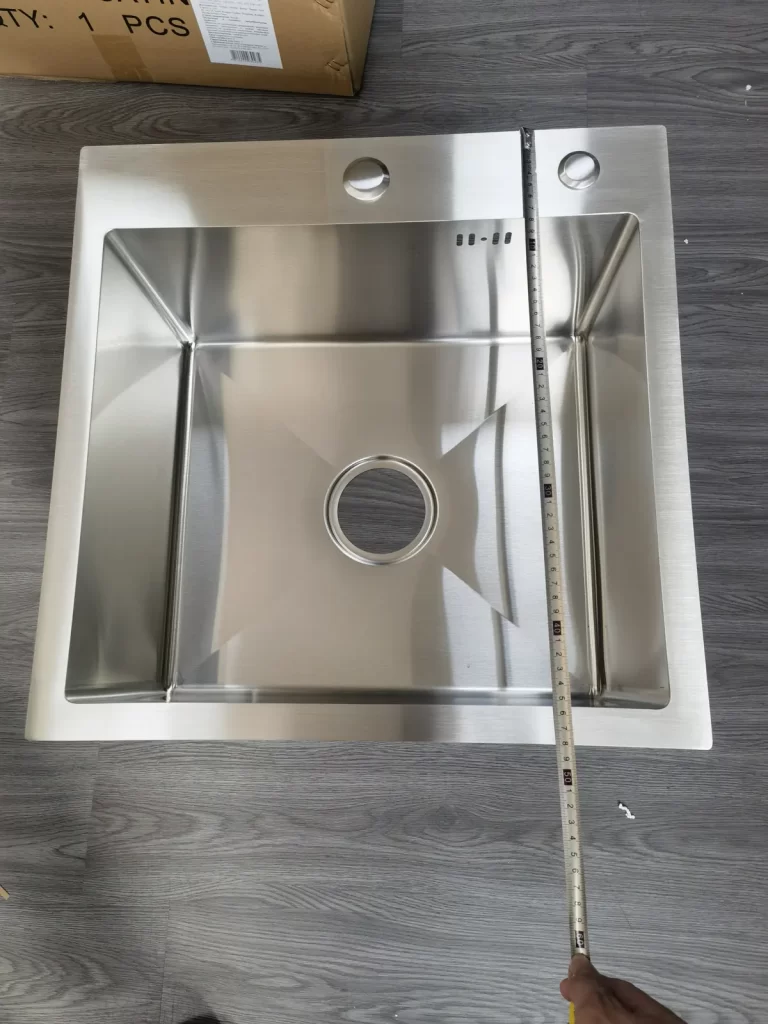
The position of the sink drain affects the available space for the P-trap, connected appliances, and cabinet storage. Before ordering, compare the sink drawing with the cabinet dimensions and locally available plumbing fittings. Do not infer bowl configuration, depth, material thickness, or accessory specifications from a product name alone. Confirm every parameter for the exact model.
Six Steps to Fix a Slow-Draining Kitchen Sink
- Remove visible debris from the strainer and drain opening, then perform an initial drainage test.
- Inspect the drain assembly, seals, and connection points for restrictions or incorrect positioning.
- Check the P-trap for buildup or blockage, reinstall it correctly, and confirm that it does not leak.
- Inspect the drain pipe for kinks, reverse slopes, insufficient diameter, or excessive adapters.
- Confirm that garbage disposal and appliance drain connections are open, secure, and correctly routed.
- Test the drainage again. If several fixtures remain slow, have the downstream drain line inspected.
Parameters Importers and Distributors Should Confirm Before Ordering
- Sink model, drain position, and drain-opening dimensions.
- Whether the drain assembly, strainer, overflow components, and connectors are included.
- Cabinet clearance and the installation space required for the P-trap and garbage disposal.
- Drain diameter, connection, venting, and installation-document requirements for the target market.
- Consistency among approved drawings, quotations, samples, packing lists, and carton model labels.
Quality Control and After-Sales Inspection
During inspection, verify the position and edge condition of the drain opening and confirm that the quantity of supplied fittings is correct. The drain assembly should match the approved sample or drawing. Packaging should prevent metal fittings from scratching the sink surface, and labels should match the enclosed instructions. After-sales records should distinguish among sink-structure issues, missing components, and problems caused by local installation.
Supply Scope and Inquiry Reference
Pressed stainless steel sinks are part of the core in-house production scope. Pressed sink thickness is generally 0.4–0.8 mm, but the material, thickness, dimensions, finish, and accessories must be confirmed for each model. For initial sourcing discussions, the typical minimum order quantity is 200 pieces per model for pressed sinks, 50 pieces per model for handmade sinks, and 20 pieces per model for quartz composite sinks. Lead time is approximately 35 days and must be confirmed according to the model, quantity, finish, packaging, and current production schedule. These figures are for preliminary discussion only and do not constitute an order commitment.
FAQ
Does a slow-draining sink always mean the P-trap is blocked?
No. The strainer, drain assembly, drain pipe slope, garbage disposal connection, or a downstream shared drain line can also reduce flow. Inspect the system in sequence before identifying the cause.
Can a dishwasher cause a kitchen sink to drain slowly?
An unopened connection, kinked hose, or incorrect connection method can affect drainage. However, slow sink drainage alone does not prove that the dishwasher is the cause.
Why should buyers confirm the sink drain position?
The drain position affects the available space for the P-trap, garbage disposal, cabinet, and dishwasher hose. Confirming the drawings and fittings before ordering can reduce pipe alterations, installation delays, and product returns.
Request Model-Specific Confirmation
To evaluate a specific project, provide the target market, sink model or category, estimated quantity, cabinet dimensions, drain accessories, finish, and packaging requirements. These details allow the drain position, included accessories, minimum order quantity, and lead time to be confirmed for the selected model.