


Connecting a kitchen sink to a dishwasher requires a safe water supply connection, a correctly routed drain hose, and a drain arrangement that prevents backflow. For importers and distributors, the same details also affect installation instructions, accessory lists, returns, and after-sales support. This guide preserves the practical plumbing steps while adding the checks a buyer should complete before approving a sink program.
How the sink and dishwasher drainage system works
A dishwasher normally discharges through a hose connected to a sink drain fitting or a compatible waste-disposal inlet. The hose must be routed so wastewater cannot flow back into the appliance. Local plumbing rules may require an air gap; where permitted, a secured high loop may be used. Installation requirements vary by market, so the final instruction sheet should follow the appliance manual and local code.
Before work begins, shut off the water supply and power to the dishwasher. Confirm that the sink drain, trap, branch fitting, dishwasher hose and hot-water connection are accessible. If the existing parts are damaged, undersized or incompatible, replace them with components approved for the local installation.
Basic installation sequence
- Confirm the sink drain outlet, trap and cabinet clearance.
- Install the branch or Y-connector in the drain arrangement specified for the market.
- Connect and clamp the dishwasher drain hose without kinks.
- Form the required air-gap or high-loop arrangement.
- Connect the appliance water inlet according to the dishwasher manufacturer’s instructions.
- Restore water and power, then test the sink and dishwasher through a complete cycle.
Check every joint for leakage and verify that water drains without backing up. If the layout is uncertain, use a qualified local plumber.
What importers should confirm before ordering sinks
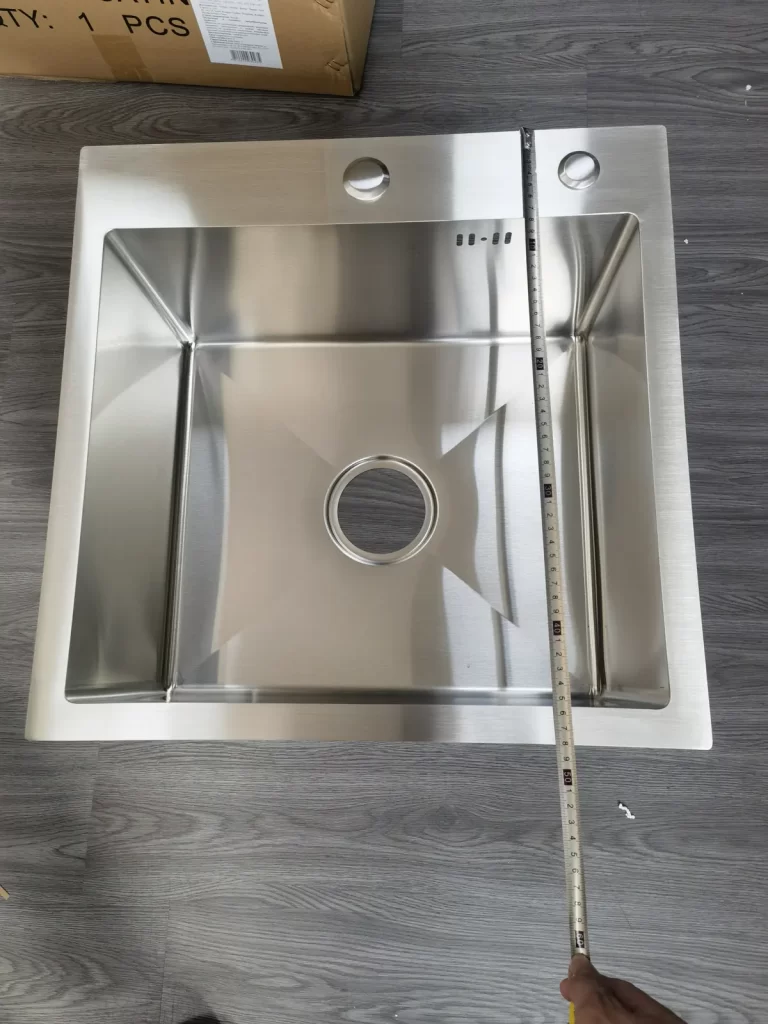
Plumbing complaints are often caused by a mismatch between the sink, drain accessories, cabinet space and local installation practice rather than by the sink body alone. Buyers should confirm the drain opening and position, bowl dimensions, cabinet clearance, overflow requirement, accessory compatibility and the intended waste-disposal arrangement for each model.
Ask the supplier to identify which drain fittings and accessories are included, which are optional, and which must be sourced locally. Packaging documents should use the same model references as the quotation and carton labels. Installation diagrams should show drain position and cabinet clearance without promising compatibility with every dishwasher or plumbing code.
Construction and specification questions
Pressed or drawn stainless steel sinks are the core self-manufactured range. Typical pressed thickness is 0.4–0.8 mm, but the exact grade, thickness, dimensions, finish and accessories must be confirmed for the selected model. Handmade stainless steel sinks are part of the supply range and require model-specific confirmation. Quartz composite sinks are partner supplied and should be checked against partner specifications.
For initial screening, typical MOQ is 200 pieces per model for pressed sinks, 50 for handmade sinks and 20 for quartz composite sinks. Lead time is about 35 days, subject to product, quantity, finish, packaging and the current production plan. These figures are screening guidance, not an order commitment.
Quality-control and after-sales checklist
- Verify drain-hole position and accessory fit against the approved drawing.
- Check that cartons, model labels and installation sheets use consistent references.
- Inspect visible surfaces and edges against the approved sample or specification.
- Confirm that drain kits are packed in the correct quantity and separated to prevent scratching.
- Keep installation instructions neutral about local codes and appliance brands.
- Record recurring installation questions and update the buyer-approved instruction sheet.
RFQ information to provide
Send the sink category or model, target market, estimated quantity, required material grade, dimensions, finish, mounting method, drain accessories and packaging requirements. The supplier can then confirm model-specific details and quotation terms.
FAQ
Can every kitchen sink connect to a dishwasher?
Not automatically. The drain arrangement, cabinet space, fittings and local code must be checked for the selected sink and appliance.
Is an air gap always required?
Requirements vary by market. Follow local plumbing code and the dishwasher manufacturer’s instructions.
What should an importer request before ordering?
Request the model drawing, confirmed material and thickness, drain and accessory list, packaging specification, MOQ and current lead-time confirmation.
CTA
Send the target market, sink model or category, estimated quantity, dimensions, finish, drain accessories and packaging requirements to request a model-specific quotation.
Подбираете партию для проекта или магазина? Запросить предложение можно в один шаг — приложите размеры и модель.